Why Change Feels Hard and What to Do About It
June 16, 2025 · 3 min read
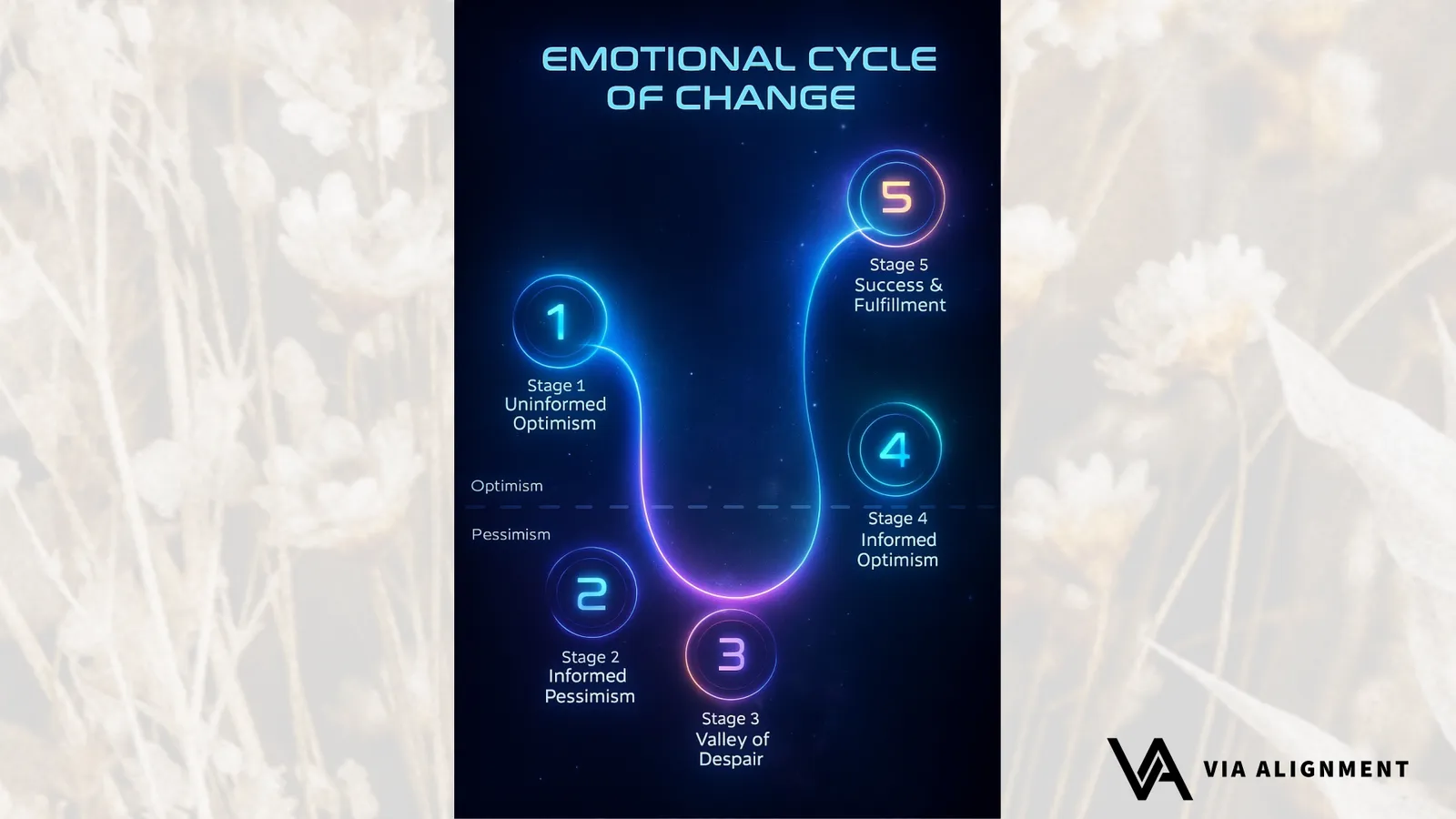
Have you ever wondered why change feels so hard?
You want it deeply, you decide, you commit, yet the results don’t come, and you simply give up.
The truth is, beyond willpower, lasting change often depends on understanding and addressing other underlying factors.
Chances are the Emotional Cycle of Change may explain why you haven’t gotten what you want yet.
Often, in my sessions, clients benefit from knowing what may be behind their actions. It is fascinating to witness their faces light up when they understand a pattern or the reason behind a behavior.
Awareness is the first step to change, and sometimes, it is the only one needed.
The Emotional Cycle of Change is a model that was developed by psychologists Don Kelley and Daryl Conner in the late 1970s, and it fascinates me how actual and accurate it is.
It describes the emotional journey involved in voluntary change. Of course, in real life, it may not be as linear as described. Yet, it gives a framework. So we can situate ourselves and move forward with more certainty.
The 5 Stages in the Cycle:
Stage 1) Uninformed Optimism - “This is exciting! I’m ready!”
Here is where we experience high hopes, excitement, and motivation. We look forward to experiencing the benefits of the change, and normally are not aware of the possible challenges ahead.
Examples:
- I just got the job of my dreams.
- I signed up for the gym; this time will be different.
Stage 2) Informed Pessimism - “Oh… this is harder than I thought.”
Motion starts, and reality kicks in. We realize it may not be as easy as we thought; difficulties begin to appear, and the cost of the change starts to become clear. Questions about whether or not the effort is worthy may arise.
Examples:
- My new job has way more meetings and politics than expected.
- I missed 2 days at the gym already and feel guilty.
Stage 3) Valley of Despair - “Maybe I’m not cut out for this.”
Here is the lowest point of the cycle. You may feel overwhelmed, frustrated, disappointed, irritated, or hopeless. You seem so far from our goal and so close to the pain. Usually, from here, two things can happen. The first is to give up and return to the old and comfortable way. The other is to have it as a turning point, as an opportunity to move through and continue stronger.
Examples:
- I’m questioning if I made the right decision by leaving my old job
- I haven’t worked out in a week and feel like a failure
Stage 4) Informed Optimism - “It’s not easy, but I’m getting better.”
Here, the clarity rises, and systems start working. If you can navigate the Valley of Despair and move through it, your chances of success increase, and you are optimistic in a realistic way. You start to feel that the cost of the change is worth it, and confidence expands with progress.
Examples:
- I’ve found my rhythm, and I’m making an impact in my new role
- I’m now exercising 3x a week consistently
Stage 5) Success & Fulfillment - “This was so worth it.”
Here we have integration, and we realize the benefits. What was difficult and painful before has become routine and the new normal. Results begin to show. We experience satisfaction and a sense of accomplishment.
Examples:
- I’m leading confidently and got positive recognition
- Working out is now part of who I am
Now it is your turn. Where are you in your change journey right now?
If you are in the Valley of Despair, please remember that you may be just one choice away from your breakthrough.
Share your experience in the comments below; your insights could be the guiding light for someone else.
Keep choosing!
Originally published on LinkedIn.
Ready to see your next step more clearly?
A clarity call is a focused conversation to understand where you are, what feels unclear, and what next step would create the most meaningful movement.