The Via Alignment Leadership Framework
March 9, 2026 · 3 min read
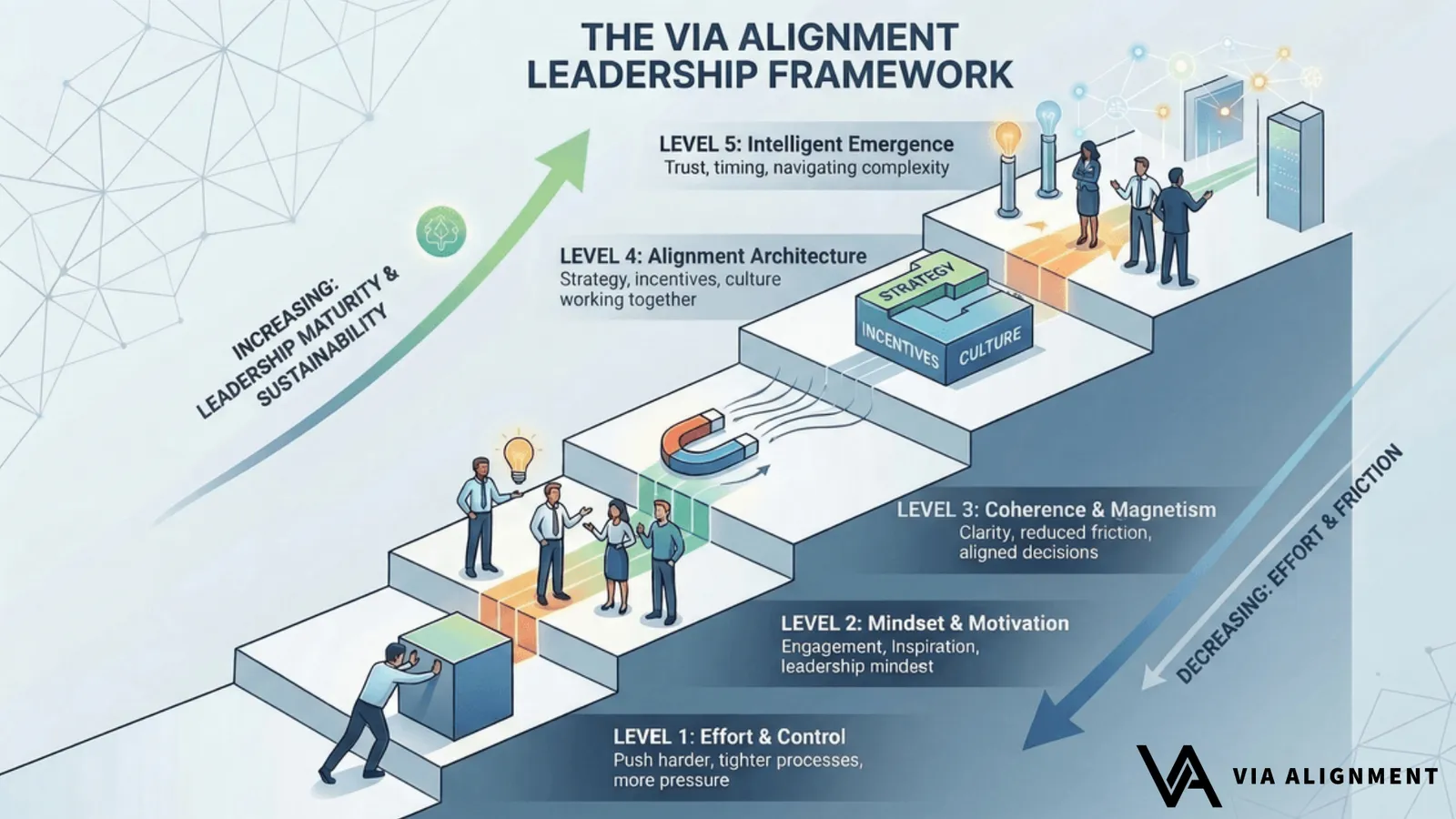
Many leadership problems are not execution problems. They are level-of-leadership problems.
Two companies can face the same challenge, produce similar short-term results, and yet operate from completely different levels of leadership. The difference shows up in the form of effort, friction, burnout, politics, and instability.
In my work with leaders and organizations, I often see five distinct levels from which performance is generated. I call this pattern The Via Alignment Leadership Framework.
Understanding these levels is powerful because it allows leaders to move from reactive performance to intentional and aligned leadership. Interestingly, organizations operating from very different levels can appear to produce similar short-term results. The difference is the path and the cost of achieving them.
It is normal for leaders to move between levels depending on context. However, before working together, I rarely see leaders consciously choosing the level they are operating from. This is where many problems begin. When leaders become intentional about how they generate results, performance tends to improve with less force and in a much more sustainable way.
One of the biggest patterns I see in organizations is that level four and five problems are often approached with level one or two solutions. When that happens, companies push harder on the wrong lever.
To illustrate this, let’s take a simple operational example.
The backlog is growing and the team is struggling to keep up.
At the first level, leaders respond through effort and control. They increase overtime, add meetings, tighten processes, and push the team to produce more through discipline and pressure. This often works in the short term, but performance becomes dependent on heroic individuals and the cost shows up later as burnout, friction, or turnover.
At the second level, the focus shifts to mindset and motivation. Leaders invest in engagement initiatives, coaching, or culture programs to increase energy and collaboration. Morale may improve, but if deeper structural or psychological patterns remain unaddressed, execution still fluctuates.
At the third level, leaders begin reducing system friction. Instead of pushing harder, they clarify priorities, align stakeholders, and create coherence in decisions and communication. Escalations decrease, work flows more smoothly, and results start to require less force.
At the fourth level, attention moves to alignment architecture. Leaders examine how strategy, incentives, roles, and culture interact. When these elements align, execution becomes self-reinforcing and the organization naturally produces better results with less rework and fewer internal collisions.
Finally, at the fifth level, leadership becomes less about control and more about orchestrating conditions. Leaders combine data, timing, and strategic intuition to navigate complexity. Instead of forcing outcomes, they create the environment where the right decisions and innovations can emerge.
The key insight is simple: the same operational problem can be approached from very different levels of leadership. The higher the level, the less force is required to produce results.
As with most things in leadership, awareness is the first step.
Which level are you operating from most often?
Which level is your team or organization operating from?
And what is the smallest shift that could move you one level higher?
Because leadership breakthroughs rarely come from pushing harder.
They come from operating from a different level.
Have an intentional day.
Originally published on LinkedIn.
Ready to see your next step more clearly?
A clarity call is a focused conversation to understand where you are, what feels unclear, and what next step would create the most meaningful movement.